Top 10 AI Voice Assistants for Customer Support in 2026
Customer support has quietly become one of the most complex operational functions inside modern businesses. By 2026, support teams are expected to deliver instant responses, consistent quality, and human-level empathy, across phone calls, callbacks, and high-volume inbound queues, while costs and staffing constraints continue to tighten.
This is where the best AI voice assistants for customer support automation 2026 have started to redefine what “good” support looks like.
Modern AI voice assistants are no longer simple call deflection tools. They listen, understand intent, manage conversations dynamically, and resolve issues end-to-end or route them intelligently when human intervention is required.
Research and enterprise adoption data from 2025–2026 show that voice automation is now being deployed not just to reduce call volume, but to improve resolution speed, consistency, and customer satisfaction, especially in industries with high inbound demand such as SaaS, healthcare, retail, logistics, and financial services. Support leaders are moving away from the question “Can AI answer calls?” toward a more practical one: “Can AI resolve the right calls well, and escalate the rest intelligently?”

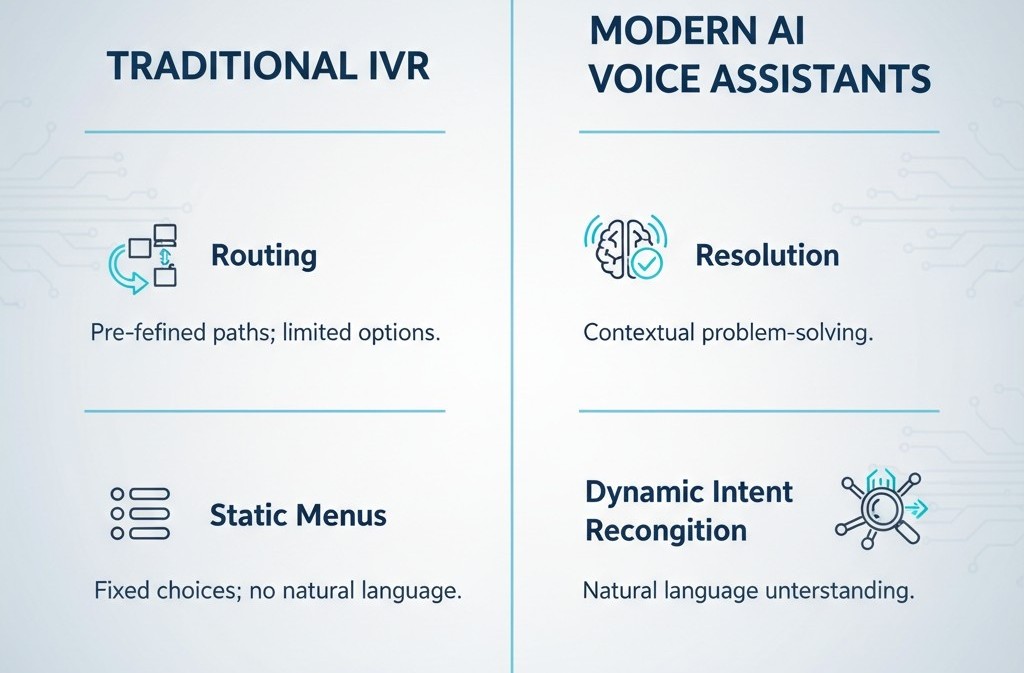
What Changed in 2026: Voice AI Isn’t “IVR 2.0” Anymore
By 2026, the biggest shift in voice automation is not better speech recognition, it’s decision-making capability. Earlier IVRs were routing systems with voice interfaces. Modern platforms operate as agentic systems that can interpret intent, decide on an action, execute it, and verify completion before ending the interaction. This is the baseline customers and enterprises now expect.
Three changes define this new standard.
- •
Intent-to-resolution replaced intent-to-routing.
Instead of identifying a reason for the call and passing it along, systems are built to complete the task when policy, data access, and risk thresholds allow it. That includes authenticating the caller, retrieving account context, performing actions (status updates, cancellations, rescheduling), and confirming outcomes. Escalation only happens when confidence drops or policy requires a human.
- •
Second, retrieval-augmented generation (RAG) became mandatory.
Voice AI in 2026 does not rely on generic model knowledge. It answers using controlled sources, approved knowledge bases, SOPs, product docs, and live system data. This sharply reduced hallucinations and made responses auditable, which is why regulated industries accelerated adoption rather than slowed it.
- •
Third, compliance and handoff logic matured.
Systems now enforce consent, redaction, and role-based access during the call itself. When a handoff is required, it is context-rich: agents receive a structured summary, verified identity, prior attempts, and the exact point of failure. Customers are no longer asked to repeat themselves.
Together, these shifts explain why the ai voice assistant for customer support is no longer positioned as a containment layer. It functions as a first-line resolver with explicit boundaries, designed to improve resolution speed and consistency without increasing risk.
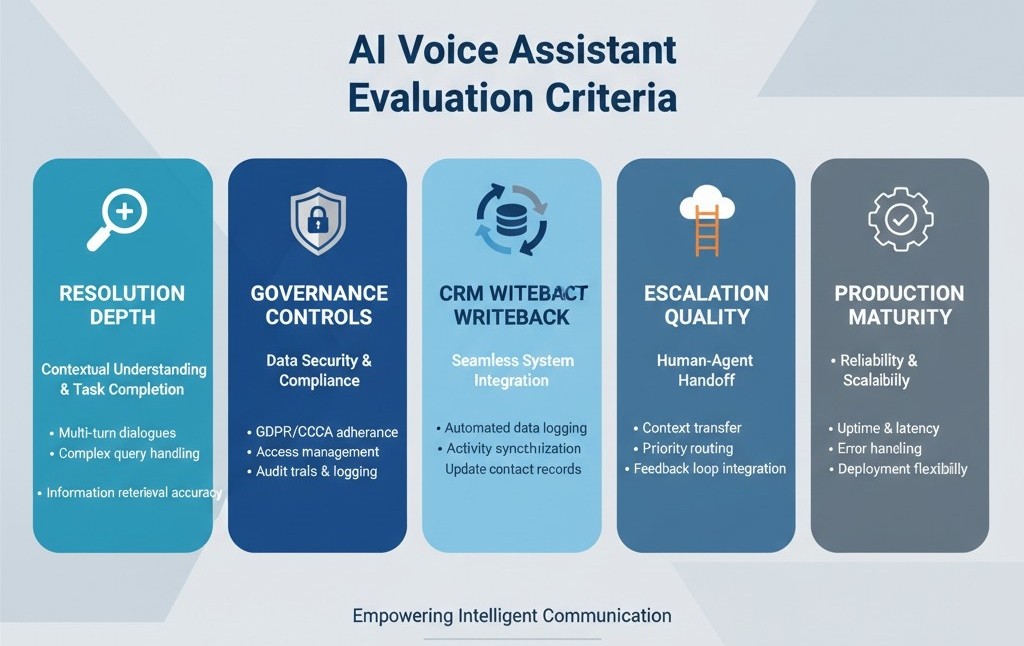
Evaluation Snapshot
Criterion | Why It Matters |
Resolution depth | Determines real impact on cost and CSAT |
Governance controls | Prevents unpredictable or risky automation |
CRM & ticket writeback | Keeps systems aligned with reality |
Escalation quality | Protects customer trust |
Production maturity | Ensures scalability beyond pilots |
This framework favors platforms that behave like operational systems, not conversational demos.
Top 10 AI Voice Assistants for Customer Support in 2026 (Ranked List)
In 2026, “voice assistant” isn’t just a product category. It’s also an implementation problem: knowledge grounding, escalation rules, CRM/ticket writeback, QA, and ongoing tuning. That’s why this ranking includes both platforms and the teams that make them work in production.
These are the best voice AI assistants for customer support to consider in 2026, based on resolution depth, governance, integration maturity, human handoff quality, and real operational fit.
1) What AI Services — Best Overall for Production-Grade Voice Support Systems
Best for: Teams that want an end-to-end support system (voice + inbox + workflows) designed around their operation, not a generic bot.
Strength: Builds the operating model: intent-to-resolution flows, RAG grounded in your SOPs/KB, governed writeback, escalation thresholds, QA signals, dashboards, and continuous tuning. You’re buying outcomes, not just software.
Watch-outs: Not a “plug-and-play SaaS.” Best suited for teams that want implementation + orchestration done right.
Typical integrations: Zendesk, Freshdesk, Intercom, HubSpot, Salesforce, custom CRMs, telephony stacks, KB/SOP sources.
Pricing signal: Project-based / managed service (scoped by volume + complexity + integrations).
2) Google Contact Center AI (CCAI) — Best Enterprise-Scale Intelligence Engine
Best for: Large enterprises with complex intents and multilingual needs.
Strength: Strong NLU + speech, robust agent-assist capabilities, and enterprise-grade knowledge grounding when implemented properly.
Watch-outs: Setup complexity is real; outcomes depend heavily on design + integration quality.
Typical integrations: Genesys, Salesforce, ServiceNow, custom contact center stacks.
Pricing signal: Enterprise / usage-based.
3) Amazon Connect + Lex — Best AWS-Native Voice Automation Stack
Best for: High-volume support centers already standardized on AWS.
Strength: Strong control over call flows, scalable infrastructure, flexible integration with backend services for real task execution.
Watch-outs: Often needs engineering to unlock the “resolve, not route” promise.
Typical integrations: Amazon Connect, CRM/ticketing via APIs, AWS services.
Pricing signal: Consumption-based.
4) Genesys Cloud CX AI — Best Omnichannel Orchestration
Best for: Organizations running voice + digital support under one routing brain.
Strength: Unified orchestration across channels, mature routing + workforce tooling, solid escalation and analytics.
Watch-outs: Some advanced capabilities vary by tier; customization can be gated by platform decisions.
Typical integrations: Salesforce, Microsoft Dynamics, ServiceNow.
Pricing signal: Subscription + AI add-ons.
5) Talkdesk Autopilot — Best “Move Fast” Mid-Enterprise Rollouts
Best for: Teams that want quicker deployment without sacrificing controls.
Strength: Strong automation patterns for support workflows, good operational visibility, clean handoffs when configured well.
Watch-outs: Best experience tends to be within the Talkdesk ecosystem.
Typical integrations: Salesforce, Zendesk, common helpdesks.
Pricing signal: Mid-enterprise SaaS.
6) Five9 Intelligent Virtual Agent (IVA) — Best for Legacy Modernization
Best for: Contact centers upgrading from older routing/IVR environments.
Strength: Mature contact center foundation with practical automation and established deployment patterns.
Watch-outs: Conversational depth varies; complex use cases may need extra layers.
Typical integrations: Salesforce, ServiceNow, Five9 platform modules.
Pricing signal: Enterprise subscription.
7) Cognigy.AI — Best for Complex Dialog + Governance
Best for: Organizations with complex policies, multi-step flows, and strict governance needs.
Strength: Strong orchestration, compliance-friendly controls, flexible integrations, and advanced workflow design.
Watch-outs: Requires serious design effort; not ideal for “quick and dirty” launches.
Typical integrations: Genesys, Salesforce, SAP, telephony providers.
Pricing signal: Enterprise licensing.
8) Kore.ai Voice — Best for Regulated, Policy-Heavy Support
Best for: Finance, healthcare, enterprise SaaS support environments with strict rules.
Strength: Strong governance and controlled automation boundaries; works well when risk decisions must be explicit.
Watch-outs: Can feel more “system-first” than “experience-first” without good conversation design.
Typical integrations: Salesforce, ServiceNow, custom systems.
Pricing signal: Enterprise SaaS.
9) PolyAI — Best for Customer Experience-Led Voice Conversations
Best for: Brands prioritizing natural conversation quality and caller experience.
Strength: Strong conversational realism and smooth flows for common intents.
Watch-outs: Deep customization and complex backend workflows may be more limited than orchestration-first platforms.
Typical integrations: Contact center platforms + CRM/ticketing via APIs.
Pricing signal: Enterprise contracts.
10) Twilio Voice + Flex + TaskRouter — Best Developer-First Customization
Best for: Teams with engineering resources building highly customized support stacks.
Strength: Maximum flexibility and control over routing, logic, and integration layers.
Watch-outs: You’re assembling a system; success depends on implementation quality and ongoing maintenance.
Typical integrations: Custom CRM/ticketing, Salesforce via connectors, internal tooling.
Pricing signal: Usage-based + build cost.
Use-Case Fit: Which One Should You Pick?
Once features look similar, fit becomes the deciding factor. Voice AI succeeds or fails based on how closely it matches your support reality: call volume, issue complexity, risk tolerance, and internal capabilities. There is no universal best option, only the right one for how your team actually works.
High-Volume, Low-Complexity Support
Best for teams handling repetitive requests like order status, appointment confirmations, or basic account updates.
Platforms with deep telephony integration and lightweight workflows perform better here than heavy orchestration tools, because every extra step slows resolution.
- •
If your backlog is stuck because your team is drowning in repeat calls, What AI Services is ideal for building a voice-first front line that resolves routine requests, updates tickets automatically, and escalates only exceptions with clean context.
Mid-Complexity Support Workflows
Best for teams dealing with multi-step requests, conditional logic, or partial resolution.
Here, value comes from structured automation rather than raw speed. Voice AI needs to pull from approved knowledge, update backend systems, and know when to stop and escalate.
- •
This is where What AI Services typically delivers the highest impact, designing intent-to-resolution workflows, grounding answers in SOPs via RAG, and implementing governed writebacks so multi-step calls stop turning into messy tickets.
Regulated or High-Risk Environments
Best for finance, healthcare, and enterprise SaaS support.
In these settings, predictability beats aggressiveness. Voice AI must respect permissions, log actions, and escalate conservatively.
- •
If compliance and trust are non-negotiable, What AI Services is a strong fit because we design strict guardrails, audit trails, permission-aware automation, and “safe escalation” logic so voice AI improves speed without creating risk.
Custom-Built Support Stacks
Best for organizations with in-house engineering teams.
These teams prioritize flexibility over speed to launch. Composable platforms allow full control over workflows, integrations, and escalation logic.
- •
If you already have internal dev resources but need the operating model and integration architecture, What AI Services can act as the build partner, mapping workflows, designing escalation thresholds, and integrating voice AI into your existing support stack without forcing a platform switch.
Bottom Line:
If you want this done as an operational system (not a demo), What AI Services is best positioned when your priority is resolution quality, governance, and a rollout that support teams adopt.