
Am I Talking to a Human or AI? Why This Question Matters More Than Ever in 2026
A few years ago, “Is this a bot?” was something people asked half-sarcastically in support chats. In 2026, it’s a serious question:
Am I talking to a human or AI?
AI doesn’t feel like a toy anymore. It’s answering phones at 2 a.m., handling refunds, chasing invoices, booking meetings, and writing follow-ups with a level of consistency that humans simply can’t keep up with.
Recent research shows 74% of customers are satisfied with their most recent AI interaction, and when the AI fully resolves the issue without escalation, satisfaction jumps above 90%. At the same time, other surveys still report that many people say they prefer human customer service and can “spot AI” from tone and repetition.
So what’s really going on?
- •
Customers are more exposed to AI than ever
- •
Regulations now require many bots to disclose they are bots
- •
Businesses are quietly moving more of their front line to AI voice and chat
And in the middle of all that, a founder or CX lead trying to deploy something like What AI Services’ AI Voice Agent or Customer Support Assistant has to answer a hard design question:
How do we use AI heavily without breaking trust the moment someone wonders, “Am I talking to a human or ai?”
This article is written for that person. We’ll stay away from “what is AI” definitions and focus on:
- •
Why people now Google phrases like am i talking to ai or a human
- •
When identity (human vs AI) actually matters
- •
How regulation is quietly killing “pretend-human” bots
- •
And how to design AI voice + support that feels responsible, modern, and conversion-safe for your brand
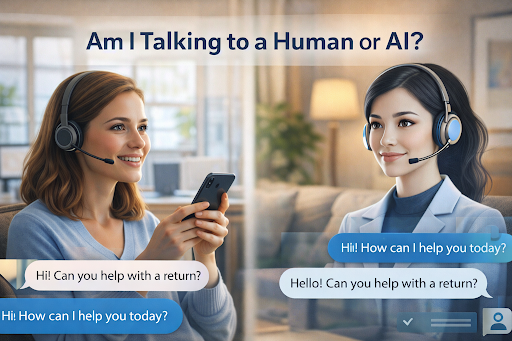
Why “Am I Talking to a Human or AI?” Exploded as a Question
The tech crossed a threshold
The question of whether I am talking to an AI or a human only shows up when the difference is no longer obvious.
Three shifts got us here:
- •
Models became context-aware, not just clever They can remember previous turns, connect to your CRM, ticketing, billing, and actually use that context.
- •
Tooling became agentic, not just generative Instead of “generate a response”, we now have systems that plan, call tools, and complete workflows in the background.
- •
Latency + cost dropped enough for production use AI moved from “pilot in a corner of the website” to “front door for 80% of inbound calls.”
So to the end user, the experience went from “obvious chatbot wall” to “strangely calm, very efficient agent who never forgets anything.”
No wonder they start thinking: “Wait, am I talking to a human or an AI?”
Customer expectations shifted faster than operations
On the demand side, customers have been very clear:
- •
They expect faster, 24/7 responses
- •
They don’t want to repeat themselves
- •
They care most about resolution, not whether the agent has a pulse
Studies show younger users (Gen Z) are already comfortable with AI fixing their issues, while older segments remain more skeptical and escalation-prone.
That’s exactly the gap a well-designed customer support AI agent can fill: give everyone the same baseline of competent, always-on help, and bring humans in where judgment and nuance actually matter.
From Meme to Reality: Where People Ask This Question
The “human or AI” games that trained everyone
Searches like am I talking to a human or AI game and am I talking to a human or AI unblocked point to a whole wave of browser games, quizzes and social media content built around one idea:
“You guess whether the reply came from a person or a model.”
This stuff matters more than it looks, because it did two things:
- •
Normalised the idea that AI can sound human
- •
Made detection feel like a challenge, not a given
So when a real user, in a real support chat, thinks “Am I talking to an AI or human”, they’re bringing that game mentality into a real-world, higher-stakes interaction.
Real life: “Am I talking to a human or AI bot?” in customer service
In actual support scenarios, people usually type something like:
- •
“To be honest, am I talking to an AI or a human?”
- •
“Just checking, am I talking to a human or a bot right now?”
That typically happens when:
- •
The agent responds very fast, with full sentences
- •
There’s no hold music, no “let me check with my supervisor”
- •
The agent navigates systems with unreal consistency
If you’re running What AI Services’ AI Customer Support Assistant or AI Voice Agent, this is exactly what you want from the ops perspective but it has UX consequences.
The solution isn’t to “act more human” by adding fake delays. The solution is to design transparent, role-based experiences where the user never feels tricked.
What People Care About (Spoiler: It’s Not Identity First)
Resolution > identity, almost every time
Studies across CX and support consistently show the same pattern:
- •
74% of customers report satisfaction with their last AI interaction
- •
When AI fully resolves the issue without escalation, satisfaction jumps above 90%
- •
When AI fails and the user has to start over, NPS falls off a cliff
Other surveys show a majority still say they prefer humans but their reasoning is telling: they believe humans resolve complex issues faster and handle multi-topic or billing problems better.
In other words: Customers don’t hate AI. They hate bad AI and badly-designed systems.
Where identity does matter
That said, the question Am I talking to AI or a human becomes critical when:
- •
Decisions impact money, health, housing, or legal risk
- •
The user is emotionally vulnerable or distressed
- •
The system is framed as a “companion” or “friend”
Trust research shows strong skepticism (65%+) around handing sensitive or irreversible decisions to AI alone.
For a business deploying AI:
- •
Routine scheduling, FAQs, status checks → users rarely care
- •
Refund disputes, cancellations, complaints → they care a lot
- •
Anything “therapeutic” or emotionally-charged → they care, regulators care, everyone cares
That’s exactly where your disclosure strategy and escalation design become non-negotiable.
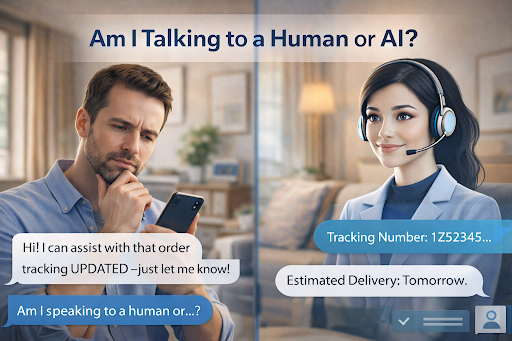
Regulation Is Quietly Ending “Pretend Human” Bots
Transparency is now a legal requirement, not a UX preference
Multiple regulatory fronts are converging on one principle:
If a reasonable person might think it’s human, you need to disclose that it’s AI.
A few examples:
- •
The EU AI Act classifies most chatbots as “limited-risk” systems but explicitly requires that users be informed when they’re interacting with AI.
- •
California’s SB 243 and related companion-chatbot laws force operators to “clearly and conspicuously” notify users when they are engaging with an AI system, especially where emotional or vulnerable users might be misled.
- •
Additional U.S. proposals (like the GUARD-style bills) similarly push for mandatory AI disclosure, particularly when minors or “consequential decisions” are involved.
In other words, the strategy “let’s make AI so human nobody notices” is now not just shady, it’s risky.
Companion chatbots vs business infrastructure
The strictest rules often target companion chatbots, systems built to simulate friendship or intimacy. Laws in California and other jurisdictions now require disclosure, safety protocols, and reporting around those experiences.
Business assistants like What AI Services’ AI Voice Agent sit in a different category:
- •
They’re framed as assistants, not emotional companions
- •
They handle calls, bookings, support operational work
- •
Their primary risk surface is accuracy and escalation, not emotional manipulation
That doesn’t mean you can ignore transparency. It means you have space to design clear, honest AI interactions that still feel smooth and modern.
Designing Conversations When You Know Users Will Wonder
Lead with role, not identity
You don’t need to open with “Hi, I’m a large language model.” You do need to avoid deception.
Best-practice pattern:
- •
“Hi, I’m the AI assistant for [Company]. I can help you with X, Y, Z or connect you to the team.”
This:
- •
Signals non-human in a calm way
- •
Anchors expectations in capabilities (“I can help you with…”)
- •
Reduces the urge for the user to test you with trick questions
Make escalation a feature, not a failure
When a user asks Am I talking to a human or AI, sometimes what they’re really saying is:
“I’m not sure this system can handle what I’m about to say.”
Good design acknowledges that:
- •
Offer a visible “talk to a human” path early
- •
Train the AI to proactively escalate when sentiment or complexity spikes
- •
Make sure the human gets a full context handover (no starting over)
This is where a voice-enabled AI support stack shines: the AI handles triage, repetitive questions, and simple workflows, while logging everything so human agents don’t have to do detective work when they join the call.
Don’t over-roleplay humanity
If your AI is over-chatty, overly affectionate, or tries too hard to bond, you’re heading straight into the zone regulators and ethicists are currently very nervous about, especially with vulnerable users.
In a business context:
- •
Keep tone warm, but clearly professional
- •
Avoid saying or implying “I’m a real person”
- •
Avoid sharing “fake personal backstories”
You don’t need AI that pretends to be Karen from Support. You need AI that acts like the world’s calmest, most prepared coordinator.

So… Does It Still Matter If It’s Human or AI?
In 2026, the honest answer is:
- •
In low-stakes, repetitive situations? Not really.
- •
In high-stakes, emotional, or irreversible situations? Absolutely.
That’s why people still search am i talking to a human or AI and why they also play with that uncertainty in lightweight contexts like Am I talking to a human or AI game.
From a business perspective, the question you should design around isn’t:
“Can we trick them into thinking it’s human?”
It’s:
“When they realise it’s AI, does the experience still feel respectful, trustworthy, and worth coming back for?”
If your answer is yes, if your AI is disclosed, competent, and backed by real humans, then the line between human and AI stops being a liability and starts being what it should have been from the beginning: A practical, well-designed collaboration.