
Best AI Customer Service Agents for Fintech Startups in 2026
Fintech didn’t just wake up to AI in 2026. The real shift is in the kind of work AI can now perform. Previously, most AI deployments were conversationalists: chatbots answering FAQs or copilots drafting emails. Now, we are seeing operators: agentic AI systems that can observe, plan, and execute tasks within your core tools, then escalate responsibly. For fintech startups, exploring the best AI contact center platforms for fintech KYC onboarding collections 2025 or 2026 is becoming a strategic priority. This is precisely why savvy fintech startups are evaluating the best AI customer service agents instead of just another chatbot.
The pressure is undeniable. Customer support queues are overflowing, compliance demands are tightening, and user expectations are for instant, Amazon-like service. Industry research is already positioning AI agents as a critical workflow layer for financial services, not a fleeting trend. They are especially powerful in operations-heavy processes that consume valuable human hours.
But there is a significant catch: the term “agentic” is being thrown around as marketing fluff. A large portion of so-called agentic AI projects are destined to fail when the reality of costs, governance, and fuzzy ROI sets in.
This guide has one purpose: to help you understand what is genuinely deployable in 2026 and how to select or develop an agentic AI system that boosts throughput without creating chaos for your compliance, security, or customer trust.

Why "Agentic" is a Game-Changer for Fintech
The core difference is "answers" versus "outcomes."
Traditional AI support tools are designed to:
- •
Generate text-based responses.
- •
Suggest potential next steps for a human to take.
- •
Leave all execution and verification to your team.
Agentic AI systems for startups go much further:
- •
Plan: They determine the necessary steps to achieve a goal, like resolving a transaction dispute.
- •
Act: They interact directly with your tools and APIs (think KYC/AML platforms, core banking systems, CRMs, payment gateways).
- •
Check: They validate the results of their actions, ask clarifying questions, and escalate to a human when their confidence level drops below a set threshold.
Fintech is filled with "small tasks that become big delays" ID verification, transaction queries, onboarding document collection, and compliance checks. This is the exact territory where autonomous task completion delivers immediate and measurable returns.
"Agent-Washing" is Real: Sharpen Your Evaluation Filter
Many vendors are simply rebranding their old chatbot technology as "agents." This trend of "agent-washing" creates confusion and leads to a high risk of project cancellation when the promised outcomes don't materialize to justify the cost.
Your essential litmus test should be: can the system complete a complex workflow from start to finish within defined guardrails, or does it just provide a polished conversational interface? This is why evaluating the best AI contact center platforms for fintech KYC onboarding collections 2025 or 2026 is critical to avoid falling for rebranded chatbot solutions. The best AI customer service agents for fintech startups in 2026 are doers, not just talkers.

Where Agentic AI Is Driving Real Value in Fintech Today
Here are examples of agentic AI applications that directly address major operational pain points for fintech startups.
1. Onboarding and KYC/AML Verification
This is a primary bottleneck where friction leads to high user drop-off. An agentic AI system can:
- •
Guide users through document submission 24/7.
- •
Perform initial data extraction and verification against third-party sources.
- •
Flag discrepancies and automatically request corrections from the user.
- •
Escalate complex or high-risk cases to a human compliance officer with a full summary.
2. Transaction Inquiries and Dispute Resolution
Instead of a human agent toggling between five different screens, an AI agent can:
- •
Instantly pull transaction histories from the core system.
- •
Cross-reference data with payment gateway logs.
- •
Execute pre-approved actions like initiating a refund for small amounts or flagging a transaction for fraud review.
3. Customer Support for Complex Products
For fintechs offering lending, investment, or insurance products, AI agents can manage intricate, multi-step queries. They can help users update beneficiaries, adjust recurring investment amounts, or process insurance claims by interacting with the relevant backend systems. This is a core function for any modern AI agent platform for startups.
4. Proactive Compliance and Financial Health Nudges
Agentic AI tools for startups are not just reactive. They can be programmed for proactive outreach, such as:
- •
Notifying users about upcoming payment due dates.
- •
Alerting them to unusual account activity.
- •
Offering personalized financial tips based on spending patterns, turning a support function into a value-add service.
The Anatomy of a Production-Ready Agentic AI Stack
A powerful agentic AI deployment needs four distinct layers to move beyond a simple demo.
- •
Channel Layer: This is the entry point for user requests (web chat, in-app messaging, email, voice).
- •
Workflow Layer: This contains the business logic, decision trees, and rules for tasks like onboarding, fraud detection, and support triage.
- •
Data & Integration Layer: This is the connective tissue to your core systemsCRM, core banking platform, KYC provider, and knowledge bases. Secure API access is non-negotiable here.
- •
Governance Layer: This is the most critical layer for fintech. It includes immutable audit logs, access controls, security policies, escalation protocols, and continuous performance monitoring.
This structure separates the flashy front-end from the robust, secure, and compliant back-end required to operate in a regulated industry. The best AI contact center platforms for fintech KYC onboarding collections 2025 or 2026 are built with this layered approach, ensuring both operational efficiency and regulatory compliance. This is what distinguishes genuine agentic AI tools for startups in 2026 from less capable alternatives.
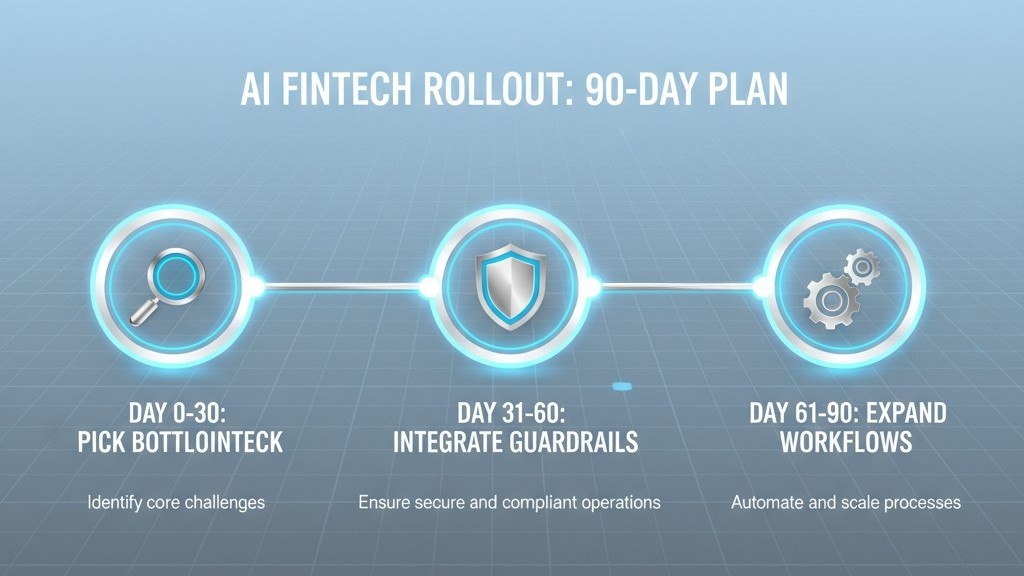
A 90-Day Rollout Plan That Builds Trust, Not Breaks It
A "big bang" launch is a recipe for disaster. A phased approach allows you to prove value, manage risk, and build internal confidence.
Days 1–15: Pick One Bottleneck and Measure Everything
- •
Choose one high-volume, low-risk workflow: User onboarding verification is a perfect starting point.
- •
Set baseline metrics: Track time-to-resolution, user drop-off rate, number of support tickets, and escalation rate.
Days 16–45: Integrate and Build Your Guardrails
- •
Connect the agent: Link the AI to your KYC provider and internal user database.
- •
Define clear rules: Program the agent with precise "can-do" (e.g., verify a standard driver's license) and "must-escalate" (e.g., a foreign passport flagged by the system) scenarios.
- •
Implement a human-in-the-loop: Ensure every escalation is routed to the right person with a complete summary of what the agent has already done.
Days 46–90: Expand and Optimize
- •
Add an adjacent workflow: Once onboarding is smooth, add an agent to handle "change of address" or "update payment method" requests.
- •
Refine the escalation process: Use feedback from your human team to make the agent's handoffs more effective.
- •
Start calculating ROI: Measure success not just in cost-per-interaction but in recovered staff hours and reduced user onboarding friction.
As you explore solutions, you'll encounter a range of AI startups in USA and globally that are building components for this new ecosystem. The key is finding a partner or a platform that understands the strict governance requirements of fintech.